

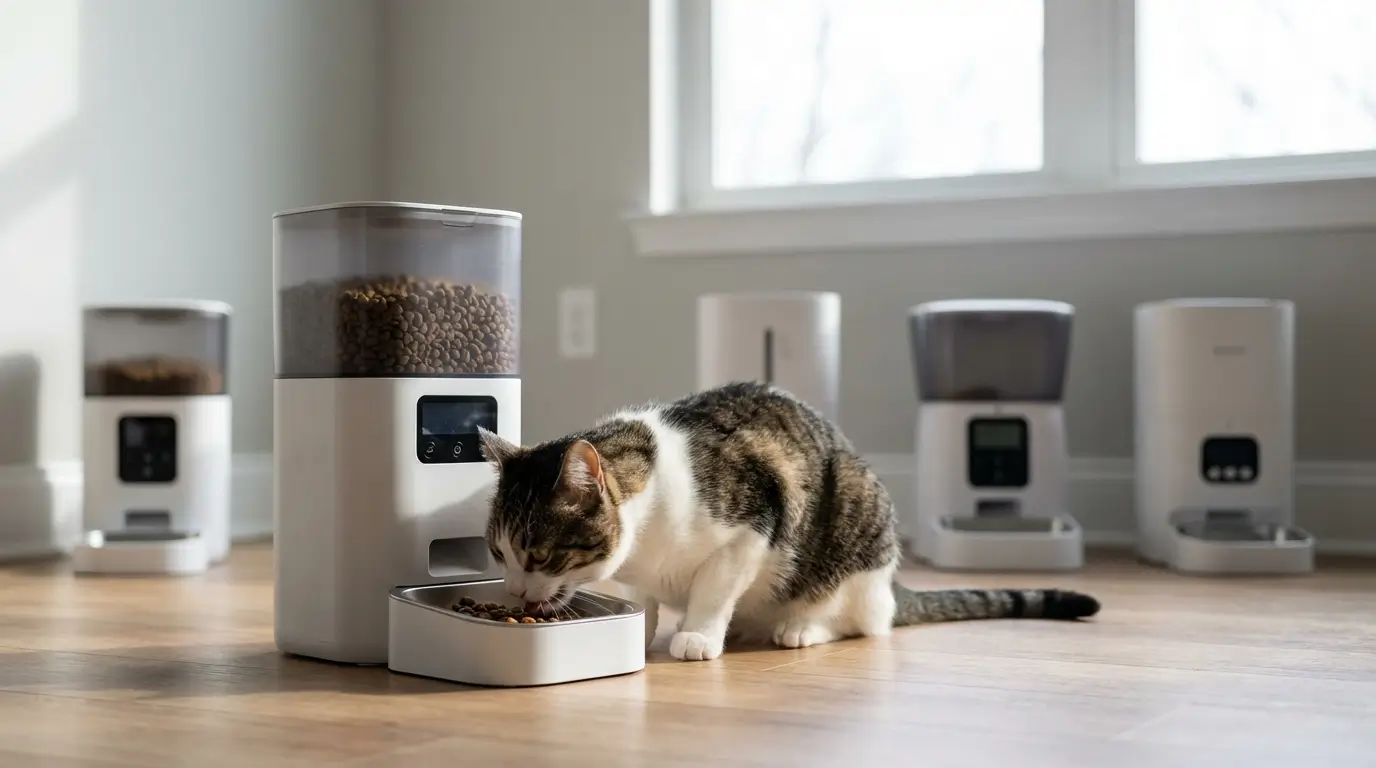
If your cat wolfs down breakfast at 7am then yowls for dinner at 3pm while you are still at work, a smart feeder can genuinely change both your lives. The right gadget will portion meals, stick to a routine, and stop the guilt of rushing home to feed them.
Why smart feeders suit busy Irish cat owners
Plenty of Irish cats spend long days indoors while their humans commute, work shifts, or juggle kids. That often means “feast or famine” feeding: a big bowl in the morning, then hours of boredom nibbling. It is not ideal for digestion, behaviour, or weight.
Smart feeders step in by offering small, timed meals through the day. That keeps blood sugar more stable and may reduce begging and night-time waking, especially in indoor cats.[1] For you, it means less clock-watching and fewer panicked texts to neighbours asking them to pop in and feed the cat.
In this comparison of the top 5 smart cat feeders for busy Irish cat owners, we will look at which types suit dry versus wet food, single versus multiple cats, and how much tech you actually need. The aim is simple: help you choose a feeder that fits your cat, your routine, and your budget.
Key features that actually matter
Most automatic cat feeder Ireland listings promise the moon: HD cameras, two-way audio, laser pointers… It is easy to get distracted. But for real daily use, a few core features matter far more than gimmicks.
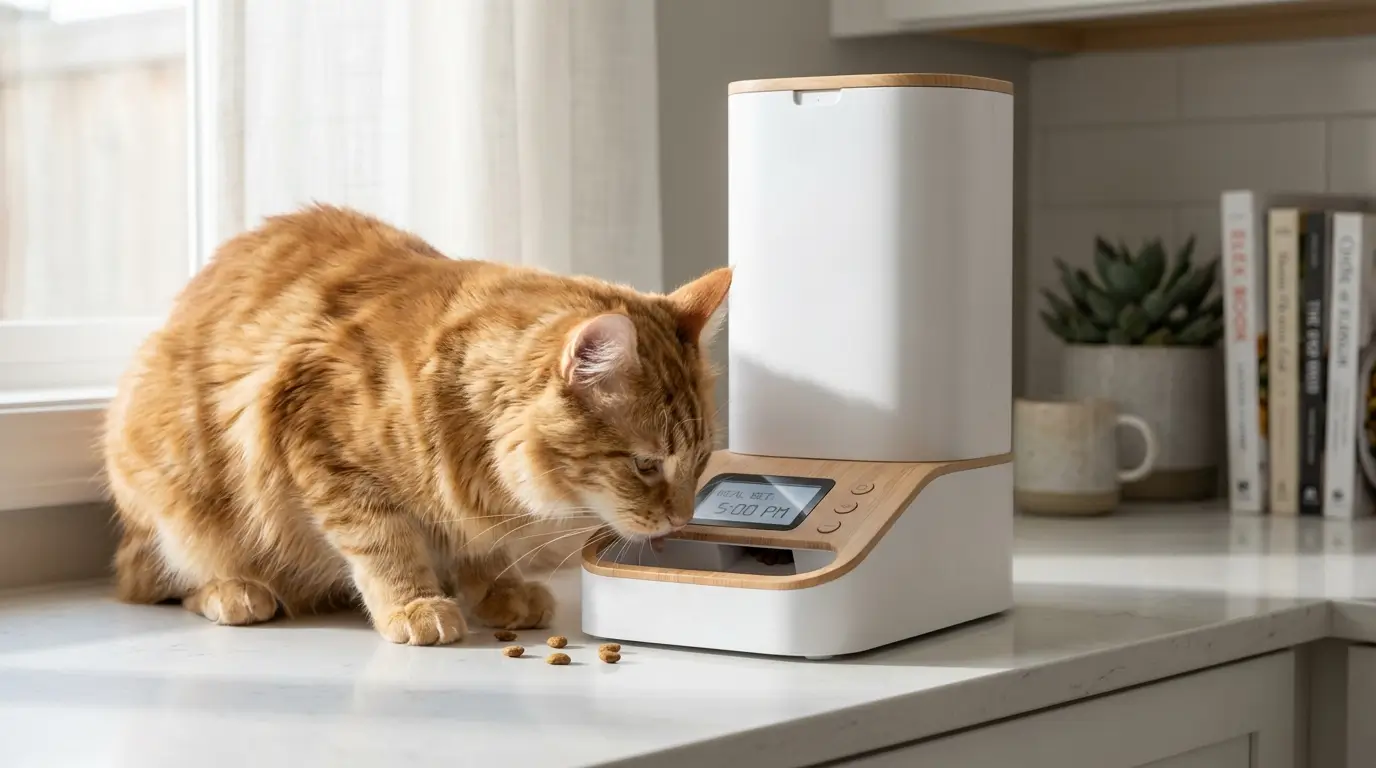
For most busy owners, focus on:
- Reliability: Solid mechanics and a clog-resistant design so kibble does not jam halfway through a work day.
- Portion control: Ability to set meal size in small increments to help manage weight and prevent overeating.
- Schedule flexibility: At least 4–6 meals per day with consistent timing; very helpful for indoor or overweight cats.[1]
- Backup power: Battery support so your cat still gets fed in an Irish winter power cut.
- Secure lid or locking bowl: Critical for food-obsessed cats that will happily break into flimsy hoppers.
From there, decide if you genuinely need a smart cat feeder with app control. App features are handy if your schedule is unpredictable or you travel often, but they are not mandatory for every household. Wi‑Fi feeders rely on a decent broadband connection, so rural homes with patchy Wi‑Fi may be better off with a simpler timed model.
1. App-controlled feeder for dry food addicts
This style of feeder is ideal if your cat eats dry food only and you want full control from your phone. A hopper holds several days’ worth of kibble, and an internal wheel dispenses exact portions at set times.
Look for an app that lets you:
- Set 6–10 meals per day with gram-based portions
- View a feeding history to spot missed meals or changes in appetite
- Trigger manual feeds when you are working late
A good smart cat feeder with app will also send alerts if the hopper is nearly empty or if a meal does not dispense, which is reassuring when you are not at home. Many have a desiccant pack inside the lid to keep kibble fresh, useful in damp Irish kitchens.
Best for: owners with unpredictable hours, indoor-only cats, and anyone actively managing weight. Because these feeders can split the daily ration into several tiny meals, they can support weight-loss plans recommended by your vet.[2] Just be sure to set the daily total to match your vet’s advice rather than guessing.
2. Simple programmable feeder for budget-conscious homes
If you do not care about apps or Wi‑Fi, a simpler timed feeder will usually do the job for less money and with fewer potential tech headaches. These typically have physical buttons and a small screen where you set meal times and sizes.
Key advantages:
- No Wi‑Fi needed – works anywhere, including rentals with patchy broadband
- Often use standard AA batteries with very long life
- Fewer settings, so less to go wrong once programmed correctly
This kind of automatic cat feeder Ireland shoppers often choose for older relatives or anyone not keen on apps. Once set up, it quietly dispenses meals without further fuss. Many hold 2–4 litres of dry food, enough for several days for one cat.
The main downside? You will typically get fewer extra features: no feeding history, no smartphone alerts, and sometimes less precise portion sizes. Still, for a healthy adult cat on dry food, it is a very practical option and usually easier on the wallet.
3. Rotating “plate” feeder – best for wet food
Dry-food hoppers are not suitable for raw or tinned food, which spoils quickly and can cause stomach upsets if left out too long. If your cat eats wet or mixed diets, a timed cat feeder for wet food with rotating compartments is a much safer bet.
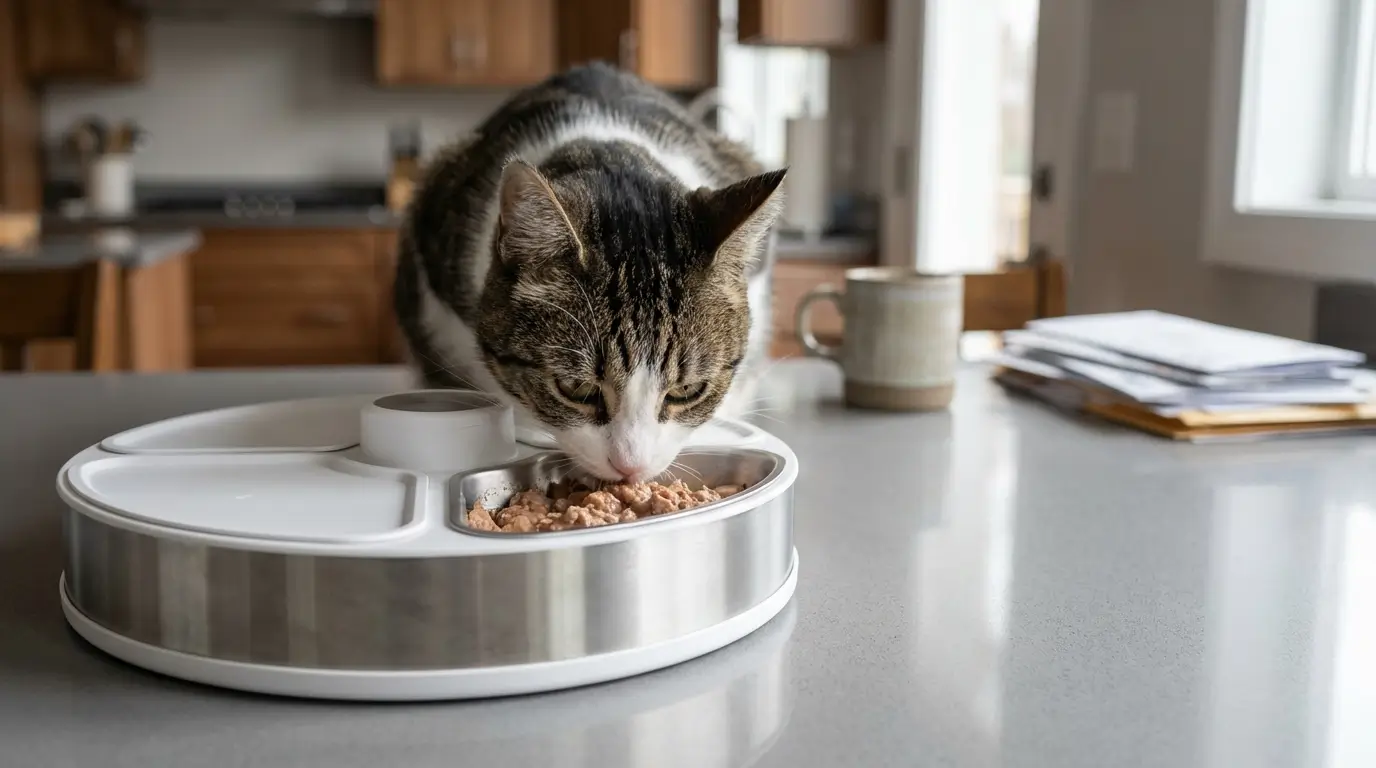
These feeders usually have:
- 4–6 covered compartments that rotate under a single opening
- Space for ice packs underneath to keep food cool for several hours
- Very simple timer settings (often up to 24–48 hours ahead)
You preload each compartment with wet food portions, then set the timings so a fresh section appears at each mealtime. It is not suitable for days away, but it is brilliant for cats that must have wet food at lunch while you are at work.
In my experience, this is also one of the best cat feeder options for multiple cats that eat together politely. Because the food is in shallow trays, several cats can snack from the same meal without one blocking the whole bowl. Greedy or bullying cats are another story – they usually need separate feeders or microchip bowls.
4. Microchip smart feeder for multi-cat households
If you have one overweight cat and one slender grazer, a standard hopper feeder can make things worse. The heavier cat will almost always eat more than their share. That is where microchip-activated smart feeders are worth their price tag.
These feeders open only for a specific cat’s microchip (or collar tag). Each cat has their own bowl and, often, their own feeding programme. This means:
- Prescription diets stay out of reach of the wrong cat
- Slow, anxious eaters can nibble through the day
- Greedy cats cannot steal extra meals
Microchip feeders are excellent for weight control and medical diets. The World Small Animal Veterinary Association notes that obesity is one of the most common problems in pet cats, with careful portion control a key part of management.[2] Having each cat’s intake controlled separately makes that vastly easier.
The downside is cost – you will need one feeder per cat – and a bit more set-up. But for complicated households, it is often the only way to keep the peace and protect special diets.
5. High-capacity hopper for busy weeks and short trips
For owners who travel overnight or work very long shifts, a high-capacity feeder with a large dry-food hopper can be a real safety net. Some models hold enough kibble for 5–7 days for one cat, depending on how you set the portions.
If you are choosing the best cat feeder for multiple cats for occasional short trips, look for:
- A large, stable base so it cannot be knocked over
- Metal or very sturdy plastic bowl to resist chewing
- Clear markings for portions so you do not accidentally overfeed
- Battery backup and a test run before you actually leave
Smart feeders are generally safe for healthy adult cats left alone for a day or two, as long as they have fresh water and a secure home environment.[3] That said, they are not a replacement for a pet sitter for longer holidays. You still need a human to check litter trays, spot signs of illness, and keep an eye on the house.
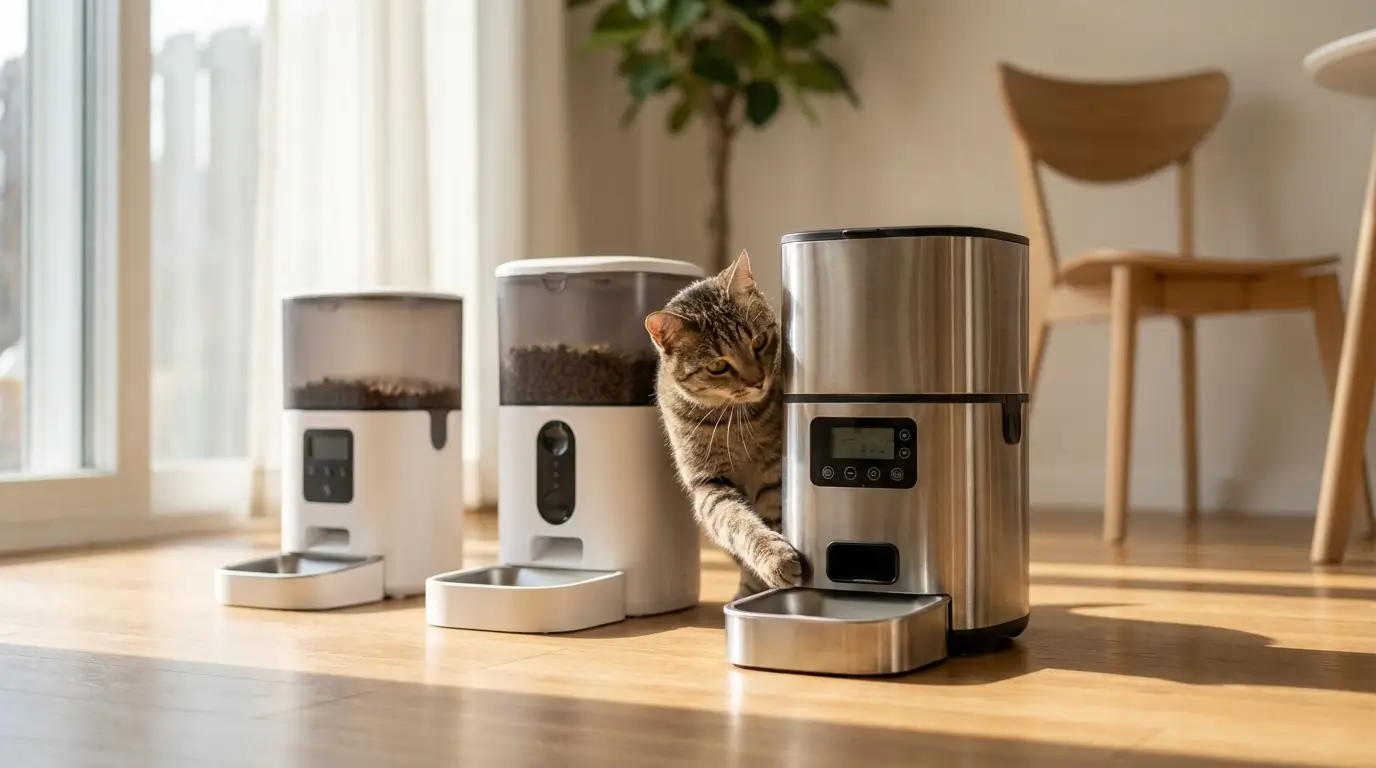
If you are tempted to rely on a feeder for weekends away, do a full test at home first: load it, leave it running for 2–3 days, and watch how your cat interacts with it. Some clever cats will try to paw extra kibble out of the chute; if that is yours, you will need a model with better locks.
Choosing the right feeder for your cat
So how do you choose between the top 5 smart cat feeders for busy Irish cat owners? Start with your cat’s actual diet and behaviour, not the box features.
Dry vs wet food
For mainly dry food:
- Pick a hopper-style feeder (app or button controlled)
- Check that it handles your kibble size – very large or odd-shaped pieces can jam in some models
For mainly wet or mixed feeding:
- Use a rotating compartment feeder for wet meals
- Combine with a simple dry-food hopper if needed
Capacity and schedule
A typical 4–5kg indoor cat needs roughly 180–250 kcal per day from complete food, depending on age and activity.[2] Your food’s packaging will list calories per 100g. Use that to calculate a daily gram total, then divide it into 3–6 small meals.
Choose a feeder that can comfortably hold 3–5 days of food at that rate, so you are not constantly refilling. For weight loss or “vacuum cleaner” cats, more frequent, smaller meals are usually better for satiety.
Safety and reliability
Always:
- Run the feeder for at least a week while you are at home
- Check the bowl and mechanism daily for jams, especially with new kibble
- Keep a small emergency bowl of food ready for use if the feeder fails
Used sensibly, smart feeders are a tool to improve routine, not replace you. You are still the one who notices furballs, sore mouths, or sudden appetite changes.
Do smart feeders help with weight and behaviour?
Many Irish vets now recommend smart or timed feeders for indoor cats struggling with weight, boredom, or food-guarding. There is good reason: spreading food across the day and controlling portions makes overeating harder and gives cats something predictable to look forward to.
Studies suggest that obesity affects up to 40–60% of pet cats in some countries, with free-feeding dry food being a major risk factor.[2] By measuring every meal and avoiding a constantly full bowl, smart feeders help you stick to a plan. Pair them with puzzle feeders or scatter-feeding for extra mental stimulation.
Behaviourally, regular small meals can reduce:
- Early-morning wake-up calls (“breakfast now please”)
- Food stealing from other cats’ bowls
- Overgrooming or mischief driven by boredom
For more ways to keep your cat settled while you are out, have a look at our posts on indoor cat enrichment and supporting anxious cats when you are at work. A smart feeder is just one piece of the puzzle – but for many homes, it is the piece that finally makes weekday life manageable.
Bringing it all together
Choosing a smart feeder is less about the fanciest app and more about what genuinely fits your cat’s diet, your household, and your budget. Dry-food hopper for the kibble addict, rotating plate for wet-food fans, microchip feeder for tricky multi-cat situations – there is a solution for almost every set-up.
If you are unsure where to start, talk to your vet about your cat’s ideal daily calories and feeding pattern, then pick the simplest feeder that can deliver that reliably. Test it thoroughly at home, keep fresh water available at all times, and remember: the goal is not to replace you, but to free you from watching the clock and let your cat eat like the little predator they are, not like a one-bowl buffet customer.
“Regular, measured meals and maintaining a healthy body condition can significantly improve your cat’s quality of life and reduce the risk of chronic disease.”[2]
Sources
- [1] International Society of Feline Medicine – Feline feeding guidelines and behaviour
- [2] World Small Animal Veterinary Association (WSAVA) – Global Nutrition Committee resources on feline obesity and feeding
- [3] Irish Society for the Prevention of Cruelty to Animals (ISPCA) – Pet care advice for cats when owners are away

5 Common Dog Health Problems

10 Best Irish Pet Rescues 2024

Indoor Cat Risks in Irish Homes